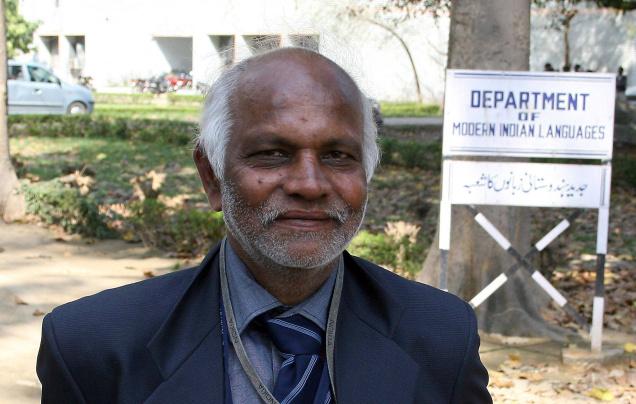
A teacher of Newman College, Thodupuzha, in Idukki district of Kerala, who was attacked by extremist elements in July on the accusation that he had hurt religious sentiments by setting a question paper with certain blasphemous sentences, was dismissed from service by the college management on Saturday.
T.J. Joseph, who was the head of the college's Malayalam Department, had two more years of service.
The management had suspended him from service in March when the question paper set for an internal examination for B.Com. students created a controversy. A few organisations took to the streets in Thodupuzha and curfew was imposed in the town.
The radical activists, reportedly owing allegiance to the Popular Front of India (PFI), waylaid his car as he was returning home from church, hacked him and chopped off his right palm
The dismissal attracted widespread condemnation in the State. In a statement, six intellectuals, led by poet O.N.V. Kurup, said the teacher had already been harassed for a lapse which took place owing to his carelessness, ignorance or lack of adequate forethought. If it had shocked democratic Kerala, his dismissal was as cruel and inhuman as the chopping off of his hand.
He hoped that the teacher would get the sympathetic support of everyone with conscience.
Other signatories to the statement are K.N .Panikkar, historian, Ninan Koshy, thinker, and the writers U.A. Khadar, P. Valsala and George Onakkkur
from The Hindu
Prof T.J.Joseph has been teaching Malayalam for last 25 years.He was never a controversial figure till March 2010. He had never indulged in activities which can be termed as against or for any particular religion.He drafted a question paper for his 32 students of BCom class. Some thought a question in that paper is hurting the religious sentiments of Muslims.That was his 'fault'. As ONV Kurup and other Intellectuals said it can be termed as owing to his carelessness, ignorance or lack of adequate forethought. He had apologised for it.
But how did a DTP printed 32 copy question paper came to be printed in large scale and distributed in mosques and educational institutions?
If you find something derogatory to your religion, will you print it in large scale and give it more publicity? Yes one will do it if one wants to get maximum political/religious mileage out of it.
Communalists are always in search of issues for hate/victim hood campaigns. Such issues are their fuel and they will try to give maximum publicity to it.But in this issue of Prof T.J Joseph my feeling is many secularists also fell into the trap laid by communalists.Without looking deep into the matter many were accusing Prof Joseph of deliberate mischief. In an article in the new issue of Mathrubhoomi weekly Prof Joseph has explained in detail how the question came into being.His explanations are reasonable for any secular minded person.
Prof Joseph's mistake was lack of adequate forethought.He can and should be pardoned. Let us hope that saner voices from Muslim community will be brave enough to rise against fundamentalist/communalist ideologies and pardon Prof Joseph accepting his apology.
If we allow the communal organisations to dictate terms in Kerala civil society, our cultural atmosphere may soon resemble that of Arabian Gulf States or Gujarat.
Sunday, September 5, 2010
Sunday, August 22, 2010
Some Onam Thoughts
Onam was my most favourite festival in my childhood.It is the favourite festival for most people of Kerala too. Why?
Is it because it is the time when we as children get new dressess?
Is it because of the 10 days of holidays we get to play and roam around?
Is it because of the 10 days of Pookalams [floral carpets] that we used to arrange on Onam days?
Is it because of the Onam feasts which may last for 3 to 4 days with some delicious preparations?
Is it because of the celebrations we used to have in campuses in the form of contests and cultural programmes?
Is it because of the 4 days of special programmes in Radio/TV?
Is it because of the Onam special editions of newspapers and periodicals which will showcase the best works of writers of Kerala?
Is it because of the yearly re-union of most of the family members?
On this Uthradam day morning [ Uthradam in the month of Chingam is considered as the first Onam day] my thoughts were wandering around these questions.
.
Mythology
Mahabali was supposed to be the grandson of Prahlad (son of Hiranyakashipu who was slain by Vishnu in his Narasimha Avataram). Prahlad, though an Asura, was a great devotee of Vishnu. Mahabali learned the love and devotion of Vishnu from Prahlad.
Mahabali became a great emperor and conquered all the 'three' Worlds.The 'Devas' did not like an Asura King conquering the World.They approached Vishnu and he came to the earth as 'Vamana'.
Mahabali was performing the sacrificial rite of the Ashwamedha Yagam. He declared that he would give anything that anyone sought from him during this Yagam. Vamana asked for an extend of land covered by his 3 foot steps. Mahabali agreed.
Vamana grew in size until he towered above the heavens. With one footstep, he measured all of the earth. With the second, he claimed all of heaven. There was still one foot of territory that Mahabali owed him. Mahabali requested Vamana to place the final step on his head as the third step of land, for he had no other left. Vamana did so and in doing so, pushed him down to Patala, the underworld.
As a last gift, Mahabali was granted permission by Vishnu to visit his subjects once a year. Thus, Keralites celebrate the Onam festival to commemorate the memory of the Great King Mahabali who would keep his promise to visit. Mahabali fulfilled his name as the great martyr for the sake of Truth ("Satya"). The name "Mahabali" itself means Great Sacrifice.
History
There is mention of Onam celebrations in Sangham Literature dating back to 300 BC. Many European and Arab travellers who came to Kerala between 500 and 1500 AD have mentioned Onam celebrations in their travelogues.
Even though the legend of Mahabali is well known throughout India, the yearly return of the King is never celebrated anywhere else in India.Why?
Was it because Mahabali ruled only in Kerala?
No explanations is readily available from history or mythology.
The folk songs of Onam describes the rule of Mahabali like this.
When Maveli ruled the land,
All the people were equal.
And people were joyful and merry;
They were all free from harm.
There was neither anxiety nor sickness,
There were no illnesses.
Death of the children was never even heard of,
There were no lies,
There was neither theft nor deceit,
Measures and weights were right;
No one cheated others.
When Maveli ruled the land,
All the people were equal.
Did such an utopian rule by a King ever exisited in Kerala?
Most probably a popular King of Kerala must have been defeated [may be by treachery] by a conquerer from other part of India.The new rulers must have connected it to the Vamana legend so as to legitimise their rule.
Is Onam celebrations a protest against Vishnu's action of dethroning a benevolent ruler?
The pyramid shaped idols made of mud/wood that is put up in front of most of the houses of Kerala on Thiruvonam day is called Thrikakara Appan.It is generally believed that Trikakara Appan is Vamana The temple at Thrikakara is a Vamana Moorthy temple.Many believe that the idols were originally meant to be that of Mahabail. The new Rulers who de throned Mahabali might have changed the rituals.The spread of Brahmanical Hinduism may have slowly changed the practice of offering 'pooja' to Mahabali to that of offering 'pooja' to Vamana,the original 'villain'of the myth. It is also said that originally Thrikakara temple was a Buddhist shrine.
It is believed that Mahabali will visit each and every home in Kerala on that day.So the houses are cleaned,new dresses are worn and beautiful floral designs are put up in front of each and every house to welcome him. So certainly Mahabali is the hero here,receiving a hero's welcome from his country men.
Onam can thus be called a festival celebrating sub-nationalism of Malayalam speaking people of India. Is this the reason why Hindu Nationalistic organisations like RSS always downplays Onam? They always try to project Sri Krishna Jayanthi and Ganesholtsvam in Kerala which occurs around the same time,which are mainly North/West Indian festivals unheard of in Kerala before 1970s.
So why I like Onam so much?
Onam is a colorful festival in many ways. It is more of a celebration of life than most other festivals. It is not related to a religion as such but to a region. It was closely related to agriculture and harvest. It has a powerful mythology behind it. It is mostly about reminiscenes of a real or imaginary past in which Kerala was an utopian land with everybody happy and contented.
HAPPY ONAM TO ALL OF YOU
Is it because it is the time when we as children get new dressess?
Is it because of the 10 days of holidays we get to play and roam around?
Is it because of the 10 days of Pookalams [floral carpets] that we used to arrange on Onam days?
Is it because of the Onam feasts which may last for 3 to 4 days with some delicious preparations?
Is it because of the celebrations we used to have in campuses in the form of contests and cultural programmes?
Is it because of the 4 days of special programmes in Radio/TV?
Is it because of the Onam special editions of newspapers and periodicals which will showcase the best works of writers of Kerala?
Is it because of the yearly re-union of most of the family members?
On this Uthradam day morning [ Uthradam in the month of Chingam is considered as the first Onam day] my thoughts were wandering around these questions.
.
Mythology
Mahabali was supposed to be the grandson of Prahlad (son of Hiranyakashipu who was slain by Vishnu in his Narasimha Avataram). Prahlad, though an Asura, was a great devotee of Vishnu. Mahabali learned the love and devotion of Vishnu from Prahlad.
Mahabali became a great emperor and conquered all the 'three' Worlds.The 'Devas' did not like an Asura King conquering the World.They approached Vishnu and he came to the earth as 'Vamana'.
Mahabali was performing the sacrificial rite of the Ashwamedha Yagam. He declared that he would give anything that anyone sought from him during this Yagam. Vamana asked for an extend of land covered by his 3 foot steps. Mahabali agreed.
Vamana grew in size until he towered above the heavens. With one footstep, he measured all of the earth. With the second, he claimed all of heaven. There was still one foot of territory that Mahabali owed him. Mahabali requested Vamana to place the final step on his head as the third step of land, for he had no other left. Vamana did so and in doing so, pushed him down to Patala, the underworld.
As a last gift, Mahabali was granted permission by Vishnu to visit his subjects once a year. Thus, Keralites celebrate the Onam festival to commemorate the memory of the Great King Mahabali who would keep his promise to visit. Mahabali fulfilled his name as the great martyr for the sake of Truth ("Satya"). The name "Mahabali" itself means Great Sacrifice.
History
There is mention of Onam celebrations in Sangham Literature dating back to 300 BC. Many European and Arab travellers who came to Kerala between 500 and 1500 AD have mentioned Onam celebrations in their travelogues.
Even though the legend of Mahabali is well known throughout India, the yearly return of the King is never celebrated anywhere else in India.Why?
Was it because Mahabali ruled only in Kerala?
No explanations is readily available from history or mythology.
The folk songs of Onam describes the rule of Mahabali like this.
When Maveli ruled the land,
All the people were equal.
And people were joyful and merry;
They were all free from harm.
There was neither anxiety nor sickness,
There were no illnesses.
Death of the children was never even heard of,
There were no lies,
There was neither theft nor deceit,
Measures and weights were right;
No one cheated others.
When Maveli ruled the land,
All the people were equal.
Did such an utopian rule by a King ever exisited in Kerala?
Most probably a popular King of Kerala must have been defeated [may be by treachery] by a conquerer from other part of India.The new rulers must have connected it to the Vamana legend so as to legitimise their rule.
Is Onam celebrations a protest against Vishnu's action of dethroning a benevolent ruler?
The pyramid shaped idols made of mud/wood that is put up in front of most of the houses of Kerala on Thiruvonam day is called Thrikakara Appan.It is generally believed that Trikakara Appan is Vamana The temple at Thrikakara is a Vamana Moorthy temple.Many believe that the idols were originally meant to be that of Mahabail. The new Rulers who de throned Mahabali might have changed the rituals.The spread of Brahmanical Hinduism may have slowly changed the practice of offering 'pooja' to Mahabali to that of offering 'pooja' to Vamana,the original 'villain'of the myth. It is also said that originally Thrikakara temple was a Buddhist shrine.
It is believed that Mahabali will visit each and every home in Kerala on that day.So the houses are cleaned,new dresses are worn and beautiful floral designs are put up in front of each and every house to welcome him. So certainly Mahabali is the hero here,receiving a hero's welcome from his country men.
Onam can thus be called a festival celebrating sub-nationalism of Malayalam speaking people of India. Is this the reason why Hindu Nationalistic organisations like RSS always downplays Onam? They always try to project Sri Krishna Jayanthi and Ganesholtsvam in Kerala which occurs around the same time,which are mainly North/West Indian festivals unheard of in Kerala before 1970s.
So why I like Onam so much?
Onam is a colorful festival in many ways. It is more of a celebration of life than most other festivals. It is not related to a religion as such but to a region. It was closely related to agriculture and harvest. It has a powerful mythology behind it. It is mostly about reminiscenes of a real or imaginary past in which Kerala was an utopian land with everybody happy and contented.
HAPPY ONAM TO ALL OF YOU
Wednesday, August 11, 2010
Imposition and banning of burqas. Two sides of the same coin
I had protested against the burqa ban imposed by the French Government in two posts titled 'Sarkozy's Fatwa?' and 'Why I oppose a ban on burqa
Now the other side of the same coin.
'A teacher of Aliah University was allegedly barred from class and then transferred because she refused to bow to the “diktat” of the students’ union to wear a burqa.
Aliah University, an autonomous institution under the West Bengal State government’s Department of Minority Affairs and Madrasa Education, was set up in 2008. It has been granted the status of a minority educational institution. Though the university does not prescribe a dress code, the West Bengal Madrasa Students’ Union insisted that all women teachers wear burqa in the classroom.
Sirin Middya was appointed a lecturer in March this year. In April, she was told by the Students’ Union that she would be allowed to conduct classes only if she wore a burqa.
“The students have no business imposing such a diktat on teachers when the university guidelines clearly state that there is no dress code. I will wear a burqa only when I feel like,” she told The Telegraph. “I was first barred from the classroom and then transferred to the university’s Salt Lake campus,” she said. There, for the past three months, she has been limited to library work though she was appointed as a Bengali teacher.
The students’ union of the university alleged that the teacher was “indecently dressed” and she would not be allowed to teach if she did not get into a burqa.“We admit there is no dress code for teachers in the university, but considering the character of the institution we insist that lady teachers wear only traditional dresses,” said Siamat Ali, the state general secretary of the West Bengal Madrasa Students’ Union. The teacher wrote to vice-chancellor Syed Samsul Alam, Anwar Hussain Dafadar, the university registrar, and Abdus Sattar, the minister of state for minority affairs.
Sirin Middya could now be allowed by the university to continue her classes, thanks to the intervention of the State Minister. “I have spoken to the Vice-Chancellor of the [Aliah] university. Such an imposition is a violation of the Constitution and it goes against our culture and will under no circumstances be tolerated….The issue will be sorted out shortly,” Minister for Minority Development Abdus Sattar told The Hindu..
On Monday, Ms. Middya received an assurance from the university that she would be allowed to conduct classes on the main campus even if she chose not to wear the burqa.
“I have received a verbal assurance, but not received any official confirmation,” Ms. Middya said.
Though pleased with the development, she said she had not yet been given a date on which she could resume her classes.
Imposing the burqa by Right-wing Islamist student Unions and banning burqa by Right-wing French politicians are two sides of the same coin of Communalism/Fundamentalism .Both should be fiercely condemned..
Now the other side of the same coin.
'A teacher of Aliah University was allegedly barred from class and then transferred because she refused to bow to the “diktat” of the students’ union to wear a burqa.
Aliah University, an autonomous institution under the West Bengal State government’s Department of Minority Affairs and Madrasa Education, was set up in 2008. It has been granted the status of a minority educational institution. Though the university does not prescribe a dress code, the West Bengal Madrasa Students’ Union insisted that all women teachers wear burqa in the classroom.
Sirin Middya was appointed a lecturer in March this year. In April, she was told by the Students’ Union that she would be allowed to conduct classes only if she wore a burqa.
“The students have no business imposing such a diktat on teachers when the university guidelines clearly state that there is no dress code. I will wear a burqa only when I feel like,” she told The Telegraph. “I was first barred from the classroom and then transferred to the university’s Salt Lake campus,” she said. There, for the past three months, she has been limited to library work though she was appointed as a Bengali teacher.
The students’ union of the university alleged that the teacher was “indecently dressed” and she would not be allowed to teach if she did not get into a burqa.“We admit there is no dress code for teachers in the university, but considering the character of the institution we insist that lady teachers wear only traditional dresses,” said Siamat Ali, the state general secretary of the West Bengal Madrasa Students’ Union. The teacher wrote to vice-chancellor Syed Samsul Alam, Anwar Hussain Dafadar, the university registrar, and Abdus Sattar, the minister of state for minority affairs.
Sirin Middya could now be allowed by the university to continue her classes, thanks to the intervention of the State Minister. “I have spoken to the Vice-Chancellor of the [Aliah] university. Such an imposition is a violation of the Constitution and it goes against our culture and will under no circumstances be tolerated….The issue will be sorted out shortly,” Minister for Minority Development Abdus Sattar told The Hindu..
On Monday, Ms. Middya received an assurance from the university that she would be allowed to conduct classes on the main campus even if she chose not to wear the burqa.
“I have received a verbal assurance, but not received any official confirmation,” Ms. Middya said.
Though pleased with the development, she said she had not yet been given a date on which she could resume her classes.
Imposing the burqa by Right-wing Islamist student Unions and banning burqa by Right-wing French politicians are two sides of the same coin of Communalism/Fundamentalism .Both should be fiercely condemned..
Tuesday, August 3, 2010
Kashmir boils
The recent disturbances and killings of scores of civilians in Kashmir made me read a book about Kashmir once again. The book 'Curfewed Night' written by a Kashmiri journalist Basharat Peer published in 2008 is a disturbing account of the life of Kashmiris.in Independent India.
The first part of the book deals with the early childhood of the author in Kashmir.Kashmir was peaceful then and armed militancy has not started yet.Later he describes how the deep sense of injustice fueled street wide protests after the rigged elections of 1987 and Gawkadal Bridge massacre by CRPF in January 1990. This went on to trigger armed militancy.
Now in 2010 history it seems is repeating itself. Kashmir is on the boil and a deep sense of injustice prevail among the civil society of Kashmir.The shouts of 'Freedom' reverberates. Instead of the armed militants funded by ISI it is the stone throwing Kashmiri youth who are in fore front protesting against the high handedness of security forces.As Kashmiri journalist Dilnaz Boga writes
Even schoolchildren have been shot in the streets during protests – 11 during June alone, with more deaths in July, indicative of the extent to which the militarisation of the Valley has impacted normal life. Despite the lack of a visible insurgency, the military apparatus continues to remain all-powerful. With the paramilitary Central Reserve Police Force (CRPF) not equipped to deal with civilians – as stated by no less an authority than E N Rammoham, former inspector-general of Kashmir – the repercussions of the heavy presence of military and paramilitary forces are being felt across the Valley.
Yesterday was the bloodiest day in recent history of Kashmir with 7 civilian deaths. The spiral of violence is continuing with each death creating more protest marches and more firing by security forces. Protesters are becoming more violent attacking Government buildings and vehicles and storming Police Stations.
Situation is completely out of control of the Government and political leadership, both in Delhi and Srinagar has been found clueless how to control the situation.
Indian mainstream media is gagged and most of the truth are not coming out.
Sanjay Kak a documentary filmmaker based in Delhi. the maker of Jashn-e-Azadi (2007) about Kashmir writes
The CNN-IBN correspondent, happily embedded inside an army truck as it made its way through Srinagar, was extolling the impact of the flag march (even as an official was busy denying that there had been any such thing). NDTV provided its usual high-wire balancing act, with Barkha Dutt dredging up the ‘pain on both sides’. The grief of the mourning father of 17-year-old Tufail Mattoo, killed when his skull was taken apart by a teargas shell, was weighed against a Central Reserve Police Force (CRPF) commandant ruing the damage to his truck’s bulletproof windscreen. But such expedient journalism paled before far more damaging hubris. While these ‘national’ reporters had the run of curfew-bound Srinagar, they omitted to mention that their Srinagar-based colleagues – local, national and even international journalists – had been locked in their homes and offices for three days
The lack of objective coverage by media is one of the reason for lack of protests against civilian killings from rest of India.Other reason may be the cry of 'Azadi' from the Kashmiri protesters which make them less acceptable to rest of Indians.But prominent Indian Civil Rights activists have issued an appeal to stop violence against unarmed civilians in Kashmir.
Why the Kashmiri youth is angry? What do they want?
Sanjay Kak writes
Most of all, even before azadi, they want justice. As they watched the Indian Army columns moving through Srinagar last month, Kashmiris would have been reminded that the protests this summer started with the Army in the killing fields of Machil., where soldiers of the Indian Army (including a colonel and a major) were charged with the murder of three civilians, presenting them as militants for the reward money So, just as elections cannot be confused with democracy in Kashmir, an elected government is no substitute for a working justice system. Meanwhile, the prolonged use of the Public Safety Act, and the dangerous license of the Armed Forces (Special Powers) Act, is slowly wearing thin for the young.
There has been no progress in ensuring justice to victims of Pathribal fake encounter killings of 2000 in which 5 civilians were killed Government is yet to give sanction to prosecute 5 soldiers charge sheeted by CBI in that case.
The best thing that the political leadership can do is to repeal or severely dilute the Armed Forces Special Powers Act and allow prosecution of all security personals accused of high handedness The Act has proved to perpetuate more violence and injustice not only in Kashmir but the whole of North East India.
Such a move may help in turning the tide against the cycle of violence and bring peace into the Kashmir valley. Otherwise get ready for a new round of Armed militancy in Kashmir and perhaps more bomb explosions in Cities of rest of India.
Monday, July 19, 2010
Greatest living legend on earth
“I have fought against white domination, and I have fought against black domination. I have cherished the ideal of a democratic and free society in which all persons live together in harmony and with equal opportunities. It is an ideal which I hope to live for and to achieve. But if needs be, it is an ideal for which I am prepared to die.”
Fortunately for the Human race he did not had to die to achieve his ideal.At 92 he is the greatest living legend on earth. He is none other than Nelson Rolihlahla Mandela who celebrated his birthday yesterday.
Nelson Rolihlahla Mandela was born on 18 July 1918 in the small village of Mvezo, on the Mbashe River, district of Umtata in Transkei, South Africa. His Father named him Rolihlahla, which means "pulling the branch of the tree", or more colloquially "troublemaker." The name Nelson was given by his first teacher in school.
Both Nelson Mandela and Oliver Tambo were expelled from Fort Hare in 1940 for political activism. Briefly returning to Transkei, Mandela discovered that his guardian had arranged a marriage for him. He secretly fled from marriage, towards Johannesburg, where he obtained work as a night-watchman on a gold mine.There he met Walter Sisulu and became more active in politics.
Mandela completed his BA and started to study Law.In 1944 he married Evelyn Mase, a cousin of Walter Sisulu. He also began his political career in earnest, joining the African National Congress, ANC. Finding the existing leadership of the ANC to be "a dying order of pseudo-liberalism and conservatism, of appeasement and compromise.", Mandela, along with Tambo, Sisulu, and a few others formed the African National Congress Youth League, ANCYL. In 1947 Mandela was elected as secretary of the ANCYL, and became a member of the Transvaal ANC executive.
In 1948 the National Party (NP) contested white only national elections with a new policy called apartheid (literally apartness) and narrowly won.. Mandela was “stunned and dismayed” at the NP’s victory.
As the White minority rulers passed more and more laws of repression the youth brigade of ANC had to act.
The existing ANC president was pushed out of office and someone more amenable to the ideals of the ANCYL was brought in as a replacement. Walter Sisulu proposed a 'programme of action', which was subsequently adopted by the ANC. Mandela was made president of the Youth League.
Nelson Mandela opened his law office in 1952, and a few months later teamed up with Tambo to create the first Black legal practice in South Africa. It was difficult for both Mandela and Tambo to find time for both their legal practice and their political aspirations. That year Mandela became president of the Transvaal ANC, but was banned under the Suppression of Communism Act – he was prohibited from holding office within the ANC, banned from attending ANC meetings, and restricted to the district around Johannesburg.
- On 26 June,1955 The Congress of the People was convened in Kliptown near Soweto in which 3000 delegates adopted the Freedom Charter.
Mandela was restricted from attending meeting, but he drove down to Kliptown to be part of the Congress of the People; and by keeping to the shadows and the periphery of the crowd, Mandela watched as the Freedom Charter was adopted by all the groups involved. His increasing involvement in the anti-Apartheid struggle, however, caused problems for his marriage and in December that year Evelyn left him, citing irreconcilable differences.
In December 1956 the entire leadership of ANC was arrested including Mandela.They were charged with "high treason and a countrywide conspiracy to use violence to overthrow the present government and replace it with a communist state." The punishment for high treason was death. The Treason Trial dragged on, until Mandela and his 29 remaining co-accused were finally acquitted in March 1961. During the Treason Trial Nelson Mandela met and married his second wife, Nomzamo Winnie Madikizela.
The 1955 Congress of the People and its moderate stance against the policies of the Apartheid government eventually led to the younger, more radical members of the ANC to break away to form the Pan Africanist Congress, in 1959 under the leadership of Robert Sobukwe. The ANC and PAC became instant rivals, especially in the townships. This rivalry came to a head when the PAC rushed ahead of ANC plans to hold mass protests against the pass laws. On 21 March 1960 at least 69 were killed when the South African police opened fire at Sharpeville.The Sharpeville Massacre, as the event has become known, signalled the start of armed resistance in South Africa, and prompted worldwide condemnation of South Africa's Apartheid policies.
Both the ANC and PAC responded in 1961 by setting up military wings. Nelson Mandela, in what was a radical departure from ANC policy, was instrumental in creating the ANC group: Umkhonto we Sizwe (Spear of the Nation, MK), and Mandela became the MK's first commander. Both the ANC and PAC were banned by the South African government under the Unlawful Organisations Act in 1961. The MK, and the PAC's Poqo, responded by commencing with campaigns of sabotage.
In 1962 Nelson Mandela was smuggled out of South Africa. He first attended and addressed the conference of African nationalist leaders, the Pan-African Freedom Movement, in Addis Ababa. From there he went to Algeria to undergo guerrilla training, and then flew to London to catch up with Oliver Tambo (and also to meet members of the British parliamentary opposition). On his return to South Africa, Mandela was arrested and sentenced to five years for "incitement and illegally leaving the country.
On 11 July 1963 a raid was undertaken on Lilieslief farm in Rivonia, near Johannesburg, which was being used by the MK as headquarters. The remaining leadership of the MK was arrested. Nelson Mandela was included at trial with those arrested at Lilieslief and charged with over 200 counts of "sabotage, preparing for guerrilla warfare in SA, and for preparing an armed invasion of SA". Mandela was given life sentence and sent to Robben Island.
The above quotation was from Mandela's speech in the court at the end of a 4 hour long statement.Here are few more excerpts from that statement given by Nelson Mandela in Pretoria Supreme Court on 20 April 1964.
."The African National Congress was formed in 1912 to defend the rights of the African people which had been seriously curtailed by the South Africa Act, and which were then being threatened by the Native Land Act. For thirty-seven years - that is until 1949 - it adhered strictly to a constitutional struggle. It put forward demands and resolutions; it sent delegations to the Government in the belief that African grievances could be settled through peaceful discussion and that Africans could advance gradually to full political rights. But White Governments remained unmoved, and the rights of Africans became less instead of becoming greater.
Even after 1949, the ANC remained determined to avoid violence. At this time, however, there was a change from the strictly constitutional means of protest which had been employed in the past. The change was embodied in a decision which was taken to protest against apartheid legislation by peaceful, but unlawful, demonstrations against certain laws. Pursuant to this policy the ANC launched the Defiance Campaign, in which I was placed in charge of volunteers. This campaign was based on the principles of passive resistance. More than 8,500 people defied apartheid laws and went to jail. Yet there was not a single instance of violence in the course of this campaign on the part of any defier. I and nineteen colleagues were convicted for the role which we played in organizing the campaign, but our sentences were suspended mainly because the Judge found that discipline and non-violence had been stressed throughout.
We had no doubt that we had to continue the fight. Anything else would have been abject surrender. Our problem was not whether to fight, but was how to continue the fight. We of the ANC had always stood for a non-racial democracy, and we shrank from any action which might drive the races further apart than they already were. But the hard facts were that fifty years of non-violence had brought the African people nothing but more and more repressive legislation, and fewer and fewer rights. It may not be easy for this Court to understand, but it is a fact that for a long time the people had been talking of violence - of the day when they would fight the White man and win back their country - and we, the leaders of the ANC, had nevertheless always prevailed upon them to avoid violence and to pursue peaceful methods. When some of us discussed this in May and June of 1961, it could not be denied that our policy to achieve a nonracial State by non-violence had achieved nothing, and that our followers were beginning to lose confidence in this policy and were developing disturbing ideas of terrorism.
It showed that a Government which uses force to maintain its rule teaches the oppressed to use force to oppose it. Already small groups had arisen in the urban areas and were spontaneously making plans for violent forms of political struggle. There now arose a danger that these groups would adopt terrorism against Africans, as well as Whites, if not properly directed. Particularly disturbing was the type of violence engendered in places such as Zeerust, Sekhukhuniland, and Pondoland amongst Africans. It was increasingly taking the form, not of struggle against the Government - though this is what prompted it - but of civil strife amongst themselves, conducted in such a way that it could not hope to achieve anything other than a loss of life and bitterness.
At the beginning of June 1961, after a long and anxious assessment of the South African situation, I, and some colleagues, came to the conclusion that as violence in this country was inevitable, it would be unrealistic and wrong for African leaders to continue preaching peace and non-violence at a time when the Government met our peaceful demands with force.
ANC was prepared to depart from its fifty-year-old policy of non-violence to this extent that it would no longer disapprove of properly controlled violence. Hence members who undertook such activity would not be subject to disciplinary action by the ANC.
Four forms of violence were possible. There is sabotage, there is guerrilla warfare, there is terrorism, and there is open revolution. We chose to adopt the first method and to exhaust it before taking any other decision.
In the light of our political background the choice was a logical one. Sabotage did not involve loss of life, and it offered the best hope for future race relations. Bitterness would be kept to a minimum and, if the policy bore fruit, democratic government could become a reality.
This then was the plan. Umkhonto was to perform sabotage, and strict instructions were given to its members right from the start, that on no account were they to injure or kill people in planning or carrying out operations. Attacks on the economic life lines of the country were to be linked with sabotage on Government buildings and other symbols of apartheid. These attacks would serve as a source of inspiration to our people. In addition, they would provide an outlet for those people who were urging the adoption of violent methods and would enable us to give concrete proof to our followers that we had adopted a stronger line and were fighting back against Government violence.
Africans want to be paid a living wage. Africans want to perform work which they are capable of doing, and not work which the Government declares them to be capable o Africans want to be allowed to live where they obtain work, and not be endorsed out of an area because they were not born there. Africans want to be allowed to own land in places where they work, and not to be obliged to live in rented houses which they can never call their own. Africans want to be part of the general population, and not confined to living in their own ghettoes. African men want to have their wives and children to live with them where they work, and not be forced into an unnatural existence in men's hostels. African women want to be with their menfolk and not be left permanently widowed in the Reserves. Africans want to be allowed out after eleven o'clock at night and not to be confined to their rooms like little children. Africans want to be allowed to travel in their own country and to seek work where they want to and not where the Labour Bureau tells them to. Africans want a just share in the whole of South Africa; they want security and a stake in society.
Above all, we want equal political rights, because without them our disabilities will be permanent. I know this sounds revolutionary to the whites in this country, because the majority of voters will be Africans. This makes the white man fear democracy.
But this fear cannot be allowed to stand in the way of the only solution which will guarantee racial harmony and freedom for all. It is not true that the enfranchisement of all will result in racial domination. Political division, based on colour, is entirely artificial and, when it disappears, so will the domination of one colour group by another. The ANC has spent half a century fighting against racialism. When it triumphs it will not change that policy.
This then is what the ANC is fighting. Their struggle is a truly national one. It is a struggle of the African people, inspired by their own suffering and their own experience. It is a struggle for the right to live.
During my lifetime I have dedicated myself to this struggle of the African people. I have fought against white domination, and I have fought against black domination. I have cherished the ideal of a democratic and free society in which all persons live together in harmony and with equal opportunities. It is an ideal which I hope to live for and to achieve. But if needs be, it is an ideal for which I am prepared to die."
In 1976 Nelson Mandela was approached with an offer by Jimmy Kruger, the Minister for Police serving under President BJ Vorster, to renounce the struggle and settle in the Transkei. Mandela refused.
In 1986 Nelson Mandela was taken to see the Minister of Justice, Kobie Coetzee, who requested once again that he 'renounce violence' in order to win his freedom.This was Mandela's response.
"What freedom am I being offered while the organisation of the people remains banned? What freedom am I being offered when I may be arrested on a pass offence? What freedom am I being offered to live my life as a family with my dear wife who remains in banishment in Brandfort? What freedom am I being offered when I must ask for permission to live in an urban area? What freedom am I being offered when I need a stamp in my pass to seek work? What freedom am I being offered when my very South African citizenship is not respected?
Only free men can negotiate. Prisoners cannot enter into contracts.
I cannot and will not give any undertaking at a time when I and you, the people, are not free.
Your freedom and mine cannot be separated. I will return".
Due to huge International pressure by trade boycott and increasing domestic political unrest the White Government was forced to release Nelson Mandela on 11 February 1990.
When South Africa's first multi-racial elections were held in April 1994, the ANC won a 62% majority.
On 10 May 1994 Nelson Mandela made his inaugural presidential speech from the Union Building, Pretoria
"We dedicate this day to all the heroes and heroines in this country and the rest of the world who sacrificed in many ways and surrendered their lives so that we could be free.
Their dreams have become reality. Freedom is their reward.
We are both humbled and elevated by the honour and privilege that you, the people of South Africa, have bestowed on us, as the first President of a united, democratic, non-racial and non-sexist government.
We have at last, achieved our political emancipation. we pledge ourselves to liberate all our people from the continuing bondage of poverty, deprivation, suffering, gender, and other discrimination. Never, never, and never again shall it be that this beautiful land will again experience the oppression of one by another... Let freedom reign. God Bless Africa!"
Mandela retired from active political life in June 1999 after his first term of office as President
Nelson Mandela never wavered in his devotion to democracy, equality and learning. Despite terrible provocation, he has never answered racism with racism. His life has been an inspiration, in South Africa and throughout the world, to all who are oppressed and deprived, to all who are opposed to oppression and deprivation.
Friday, April 23, 2010
Is more Government Control good or bad?
With demise of Soviet style Socialism in the 1980s most people believed that Government control of affairs of the society will become less and less and Laissez-faire Capitalism will rule the World.But it did not happen.Governments in most of the Western World is trying to control their economies more than before. Is more Government control good or bad?
Let me try to define Laissez-faire Capitalism.
Ayn Rand the Russian-American writer,a staunch supporter of Capitalism said
When I say “capitalism,” I mean a full, pure, uncontrolled, unregulated laissez-faire capitalism—with a separation of state and economics, in the same way and for the same reasons as the separation of state and church.
Actually no country followed Laissez-faire economic system. But most of the Western European countries and USA had a relatively free market economy though with varying degree of Government control.
But after the economic crisis of 2008-09 the Governments are thinking about controlling their economies more and more.
In USA, President Barack Obama's Democratic Party is trying to pass an economy regulation legislation which will increase the control of Government on the financial system.
In a speech today in New York Obama said:
I believe in the power of the free market. I believe in a strong financial sector that helps people to raise capital and get loans and invest their savings. But a free market was never meant to be a free license to take whatever you can get, however you can get it. That is what happened too often in the years leading up to the crisis. Some on Wall Street forgot that behind every dollar traded or leveraged, there is a family looking to buy a house, pay for an education, open a business, or save for retirement.
I have also spoken before about the need to build a new foundation for economic growth in the 21st century. And, given the importance of the financial sector, Wall Street reform is an absolutely essential part of that foundation. Without it, our house will continue to sit on shifting sands, leaving our families, businesses and the global economy vulnerable to future crises. That is why I feel so strongly that we need to enact a set of updated, common-sense rules to ensure accountability on Wall Street and to protect consumers in our financial system.
It is widely agreed that the economic recession of 2008 could have been avoided if the Government had intervened to control unbridled sub prime lending and Mortgage frauds. It is also now clear that it was the bailout by Government using tax payers money that helped to prevent bankruptcy of many Companies.
Recent revelations that Goldman Sachs duped its own customers and made big profits raises the need for more Government regulation in Banking sector.
“The simultaneous selling of securities to customers and shorting them because they believed they were going to default is the most cynical use of credit information that I have ever seen,” said Sylvain R. Raynes, an expert in structured finance at R & R Consulting in New York. “When you buy protection against an event that you have a hand in causing, you are buying fire insurance on someone else’s house and then committing arson.”
Let me quote Obama again:
"It is for this reason that we need a system to shut these firms down with the least amount of collateral damage to innocent people and businesses. And from the start, I've insisted that the financial industry -- and not taxpayers -- shoulder the costs in the event that a large financial company should falter. The goal is to make certain that taxpayers are never again on the hook because a firm is deemed "too big to fail.
"In the end, our system only works -- our markets are only free -- when there are basic safeguards that prevent abuse, that check excess, that ensure that it is more profitable to play by the rules than to game the system. And that is what these reforms are designed to achieve: no more, no less. Because that is how we will ensure that our economy works for consumers, that it works for investors, that it works for financial institutions -- that it works for all of us.
I agree with Obama here. More Government controls,safeguards and regulation will only help the economy.
As the Nobel Prize winning economist and a strong supporter of economic regulations by the State, Paul Krugman said:
For the fact is that much of the financial industry has become a racket — a game in which a handful of people are lavishly paid to mislead and exploit consumers and investors. And if we don’t lower the boom on these practices, the racket will just go on.
Let me try to define Laissez-faire Capitalism.
Ayn Rand the Russian-American writer,a staunch supporter of Capitalism said
When I say “capitalism,” I mean a full, pure, uncontrolled, unregulated laissez-faire capitalism—with a separation of state and economics, in the same way and for the same reasons as the separation of state and church.
Actually no country followed Laissez-faire economic system. But most of the Western European countries and USA had a relatively free market economy though with varying degree of Government control.
But after the economic crisis of 2008-09 the Governments are thinking about controlling their economies more and more.
In USA, President Barack Obama's Democratic Party is trying to pass an economy regulation legislation which will increase the control of Government on the financial system.
In a speech today in New York Obama said:
I believe in the power of the free market. I believe in a strong financial sector that helps people to raise capital and get loans and invest their savings. But a free market was never meant to be a free license to take whatever you can get, however you can get it. That is what happened too often in the years leading up to the crisis. Some on Wall Street forgot that behind every dollar traded or leveraged, there is a family looking to buy a house, pay for an education, open a business, or save for retirement.
I have also spoken before about the need to build a new foundation for economic growth in the 21st century. And, given the importance of the financial sector, Wall Street reform is an absolutely essential part of that foundation. Without it, our house will continue to sit on shifting sands, leaving our families, businesses and the global economy vulnerable to future crises. That is why I feel so strongly that we need to enact a set of updated, common-sense rules to ensure accountability on Wall Street and to protect consumers in our financial system.
It is widely agreed that the economic recession of 2008 could have been avoided if the Government had intervened to control unbridled sub prime lending and Mortgage frauds. It is also now clear that it was the bailout by Government using tax payers money that helped to prevent bankruptcy of many Companies.
Recent revelations that Goldman Sachs duped its own customers and made big profits raises the need for more Government regulation in Banking sector.
“The simultaneous selling of securities to customers and shorting them because they believed they were going to default is the most cynical use of credit information that I have ever seen,” said Sylvain R. Raynes, an expert in structured finance at R & R Consulting in New York. “When you buy protection against an event that you have a hand in causing, you are buying fire insurance on someone else’s house and then committing arson.”
Let me quote Obama again:
"It is for this reason that we need a system to shut these firms down with the least amount of collateral damage to innocent people and businesses. And from the start, I've insisted that the financial industry -- and not taxpayers -- shoulder the costs in the event that a large financial company should falter. The goal is to make certain that taxpayers are never again on the hook because a firm is deemed "too big to fail.
"In the end, our system only works -- our markets are only free -- when there are basic safeguards that prevent abuse, that check excess, that ensure that it is more profitable to play by the rules than to game the system. And that is what these reforms are designed to achieve: no more, no less. Because that is how we will ensure that our economy works for consumers, that it works for investors, that it works for financial institutions -- that it works for all of us.
I agree with Obama here. More Government controls,safeguards and regulation will only help the economy.
As the Nobel Prize winning economist and a strong supporter of economic regulations by the State, Paul Krugman said:
For the fact is that much of the financial industry has become a racket — a game in which a handful of people are lavishly paid to mislead and exploit consumers and investors. And if we don’t lower the boom on these practices, the racket will just go on.
Tuesday, April 13, 2010
The sad story of Dr Siras.Time to end this moral policing
Dr Srinivas Ramachandra Siras,Chairman of the Department of Modern Indian Languages at Aligarh Muslim University was about to retire from his job in September this year after 22 years of distinguished service.. But on February 19, 2010 he was suspended from his job and was asked to leave the University campus vacating his quarters. His crime.....? Having consensual sex in the privacy of his quarters. All the hell broke loose because of a minor factor. His partner was a man.
The Vice Chancellor said he is being suspended for grave misconduct. The suspension was on the basis of a video recording filmed inside Dr Siras's quarters with out his consent.
Dr Siras approached the High Court. On April 1 a Division Bench of Allahabad High Court stayed the suspension and allowed Dr Siras to resume his work and to live in his quarters.
On April 4 Dr Siras approached the Chief Judicial Magistrate seeking action against AMU officials and media persons for intruding his privacy, harassing and blackmailing him.
The life less body of 62-year-old Siras, was found on April 7 lying on the bed in his private apartment outside the University. It was believed that he died at least 2 days ago, may be on April 5, the day after he approached the Court against University authorities. Cause of death is still not known.
Was he killed? Or did he commit suicide? He was on the verge of a personal victory after the High Court order. He proved that he is a fighter by approaching the Court against University authorities. Will such a person take his own life at that particular juncture?
The family members and the Teachers Association have demanded high level probe into the matter.
Some people on the AMU faculty believe that the Vice Chancellor of the University was trying to divert attention from the negative publicity it had received with the recent inquiry ordered by the President of India, Pratibha Patil, after instances of financial bungling and mismanagement came to light. They believe that the video filming was arranged and paid for by top administrators of the University.
A first information report (FIR) was finally registered against four Aligarh Muslim University (AMU) officials and some journalists for breaching the privacy of Dr Siras, on April 9. The case was registered only because of the directions of the court.
The Integrated network of sexual minorities of India [INFOSEM] has started an online petition campaign in this issue. The network demands a judicial enquiry into the whole issue and the suspension of the Vice Chancellor; they want the AMU to respect the rights of its faculty and students, especially their privacy in matters of sex, sexuality and gender.
Aligarh Muslim University is supposed to be the bastion of minority religious rights. But when it comes to the rights of sexual minorities AMU was found inept in ensuring justice.
In view of the recent landmark Delhi High Court judgment legalising Gay sex, let us hope that at least in future, rights of sexual minorities will not be trampled upon by society.
Subscribe to:
Posts (Atom)